

Trusting Strangers
a daughter's "how to"

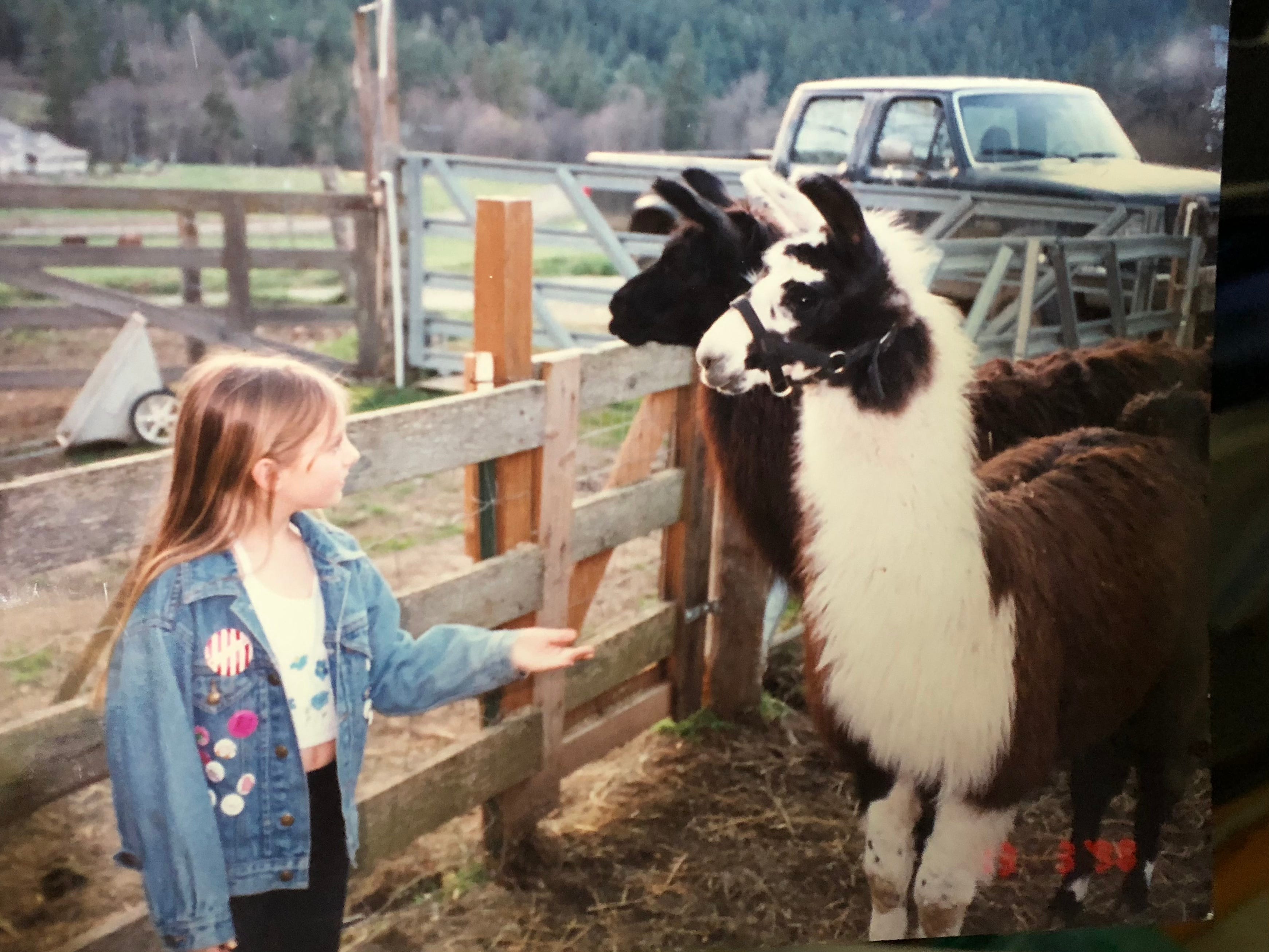
In third grade I held a precious baby lamb in my lap as I sat cross legged in a pile of hay. I watched its ears flap and twirl, having had no clue a creature could be so cute, or a moment could be so idyllic. I was in Oregon, visiting my friend Sara on her family’s farm. Sara held a baby lamb in her own lap. They were siblings, these new little muppets, bleating at each other as Sara and I registered this moment as probably the best of our entire little lives. Sara’s mom exclaimed, “Let’s name them, Sara and Alexandra!” Oh my god, I thought. It’s my baby, I decided right then and there. I will fly from California to this Oregon farm every weekend. I will send Alexandra toys and letters in my absence. My new obsession! My lamb! My baby!
After that trip, I never saw Alexandra again. But at home in LA, I told everyone about my “sweet baby lamb,” and thought of her often. I wondered if I’d ever feel that maternal again, if I’d ever again hold something so adorable and precious. For an eight year old, a real high worth chasing.
Not too long after that momentous trip, I waited in line with my dad at a food court’s “Greek” restaurant. And it suddenly dawned on me that, Gyros, the item he and I regularly ordered, might be lamb.
“Daddy, what’s Gyros?”
“Yee—rrrrowsss, pronounced Yee-rrrrowsss, Peach.”
(That was almost exactly how I had said it, but correcting me was my dad’s favorite sport).
I tried again with a more rolled R, “What’s in Gyrrros? What animal is it?”
He barely paused. “Chicken.”
“Good, ‘cuz I don’t eat lamb anymore.”
“I know, Peachy. You love Alexandra.”
“She’s soooooo cute, cute, cute!” I curled my fingers, my knuckles framing my jaw.
His stern voice emerged, “You will have to eat lamb again, though.”
I knew my dad would take my new stance personally. He loved cooking lamb meatballs, shaped less like spheres and more like large pointy olives, doused in thyme, black pepper and carefully selected olive oil. He’d lay the lamb on strategically flavorless rice to soak up the meat’s oily over-seasoning. A decadent meal he took great pride in serving me. A man, a deadbeat father, often berated for all the times he didn’t feed his kids.
Despite the frustration I knew it would summon, I gave my meanest, most defiant look to the very face it came from: No I will not have to eat lamb again. He shot it right back at me: Yes, you will. And a cashier was paid to break the tension,
“Hi, what can I get you two?”
My dad reached for his wallet, “Two Yee- rrrrrrrross plates please.”
I tried not to laugh at his desperate attempt to impress an underpaid “Greek Kabob” employee who certainly did not give two shits my dad could speak fluent Greek.
For all his faults, I always appreciated how comfortable I felt talking to my dad like he was my equal. It helped that I didn’t idolize him, or really even think of him as good at being an adult. Even as an eight year old, I understood that he was immature, which made him more like me, a lost kid. Yes, I wanted him to grow up, be more like my friends’ dads, but for the time being, while I still had growing up to do, I could level with him. I told him about a girl in school who was teasing me for wearing affordable clothes. He responded with, “That sucks, not having nicer clothes. That really sucks.” As if that was the lesson. But the validation, the twinship with my own immaturity, was like a homemade quilt on a nippy day. Our American junk food played the part of Greek cuisine, and we played the part of a stable father and daughter. We gabbed over scratched plastic trays like two middle schoolers in a cafeteria. For all his many, many faults, I was never afraid to tell my dad exactly how I was feeling. I could say, “I stole something” and he’d reply, “I stole ten things.” You were always ‘not that bad’ in his presence.
We finished our pleasant lunches, two big babies. And once we had tossed our trash, and brought our trays to the counter, my father turned to me and smirked, “Gyros is lamb by the way.”
I can still feel the tightness in my forearms thinking about it. I was so livid, and deep down probably not all that surprised. But I didn’t have the words then for what was actually forming through my psyche, witnessing new possibilities, the risks, that can accompany our natural instinct to trust an adult we love. Sick to my stomach in every sense of the phrase. I can be there right now. With my dad now gone, I often subconsciously revisit my memories of him to keep him alive. I relive them, this time as my adult self in my little body. I turn to him right now, in that food court, from my sofa:
I find the best in you! For both of us! I do it for both of us. And you bite me anyway. And I still really love you, who you actually are. Loving someone like you earns me the Gold Medal. Because it’s hard to love a cruel man, but I do it, and it looks effortless. I stick the landing. They will name this impossible move after me. After you trained me. It would feel so good to trust a coach and say he’s mine. But I will never know how that feels. How proud should I be? What’s this Gold even made of? A once darling, now slaughtered, little lamb.
That was the last time I remember intentionally trusting my father. From then on, I’d genuinely check a clock after asking him the time, knowing he’d pick whatever minute best served his needs. With my dad, the pieces were always moving, I never knew for sure what I could stand on. Suspicion was a member of the family for whom I’d always need to save a seat, at home, in a food court, at school, in new relationships, whether or not my dad was there.
If you live on Earth, I’m sure you’ve been burned too. Maybe even by the person you love most. I write Substack posts in an effort to connect with people I don’t know, or to make someone I don’t know feel less alone. If you relate, you understand how unwelcome the Distrust Genie is, us knowing he can never return home. Once you realize you can’t trust a person, that information cannot be unlearned, and it dawns on you that all people are capable of deceit. Once that pathway is formed in your brain you can shovel dirt in and pack it closed, but the walls will always remain. An archaeologist will always be able to find them. And when the pain of distrust’s permanence colors my view of humanity, when the whole world seems evil and undependable, I am not my best self, I am not warm and open. New, needed bonds cannot form through folded arms and wondering "who the fuck are you, really?”
Fred Rogers told us to “look for the helpers” whenever we find ourselves doubting mankind. But he wholesomely didn’t acknowledge how much harder helper-seeking is for those of us with crippling trust issues. Still, per Fred’s advice, when I spiral, when I believe everyone outside my door is bad, it behooves me to pull up memories of supportive strangers. I’ve met them. Haven’t you?
In March of 2020, I entered a grocery store to stock up for the first (and most terrifying) Covid lockdown. I’d never seen my neighborhood market in such a frenzy: empty shelves, pushy people, it was the stuff of apocalyptic movies rattling all my real life senses. I kept up with the flow of traffic, snatching food, wondering if this necessary errand would literally kill me. I topped my overflowing basket with a massive box of blueberries, and headed towards the checkout counters. Weaving in and out of panickers, I noticed my fragile plastic carton of blueberries teetering over the edge of my basket and grabbed them with my free hand, only to drop them on the ground. The box popped right open, and what felt like a million blueberries scattered all over the floor tiles, flattened left and right by crazed customers. I crouched, whining, not knowing whether I was supposed to scoop them up or keep moving. And a woman who was probably in her late sixties crouched down next to me. She was an employee, and she spoke impossibly calmly in a stampede. “I’ve got this, Sweetheart. Don’t worry. Don’t touch these. You wait in line over there and I can get you more berries.” She pointed me towards the shortest line. I told her to absolutely not worry about more berries; that box was the last one anyway. She insisted she could find me another box. And somehow she did. I was baffled by her energy’s existence. I thought about how she was definitely not being paid enough to work there on a good day. I thought about how she deserved to be safe, to have her tired feet up. And I thought about how her behavior was rare and day-changing. I wished her personality had been as contagious as Covid. I wished her dependability was the norm.
When I’m alone with my thoughts, and they are pessimistic and unkind, it soothes my soul to remember that one grocery employee’s nature, and the existence of others like her. I’m comforted by the thought of 24-hour Suicide Hotlines, Abuse Hotlines, Treatment Center Hotlines, the list goes on. 12 Step meetings made up of volunteers are taking place around the clock, around the world. Wherever and whenever you are, right now even, someone, somewhere is setting up chairs, waiting by the phone, ready and willing to be depended on. Even if I don’t utilize them, I sleep better thinking of them. I hope thinking of them soothes you too.
“Self care” has become sort of a buzzword the last few years (not not thanks to beauty brand marketing teams). And I think self care’s fairly new popularity is great news; I love how therapizing one’s self is almost the norm. But I often see the concept of service being excluded from the conversation. We forget that being of service falls under the self care umbrella too, an esteem builder, a purpose maker, a bond forger, a trust exercise from the other side.
Some of us were trained early to be more pessimistic than others. Mr. Rogers said to look for the helpers when we’re feeling hopeless. So I did. And after I found them, I befriended them, studied them, and asked how I could be one of them. The helper community fed, and still feeds, my hungry heart. It starves the wounds that hate all people, and feeds the lamb loving little girl who prefers trusting humanity, serving her something she’s agreed to consume.
What a touching, soul bearing essay!!
Whew. Feeling this one today. Thank you.